메뉴
Equipment

Fully Automatic Winder vs. Semi-Automatic Winder

A practical comparison of fully automatic and semi-automatic winders at the final stage of PP and PET strap production.

Equipment

Why the winder decision matters

The winder is the final stage of a PP or PET strap extrusion line. Even when extrusion, stretching, embossing, and heat setting are stable, poor winding can create problems in the finished product: unstable coil shape, uneven tension, loose edges, difficult unwinding, or extra manual handling.

For this reason, the choice between a fully automatic winder and a semi-automatic winder should not be made only by comparing automation level. Plant managers and production engineers should also consider bobbin size range, operator workflow, product change frequency, packing requirements, and available floor space.

Both types can produce commercial strap coils, but they fit different production priorities.

Basic difference

A semi-automatic winder performs automatic winding, but some steps still require operator action. Depending on the line layout and coil specification, the operator may need to load or remove bobbins, cut or fix the strap, handle the finished coil, or prepare the next winding cycle.

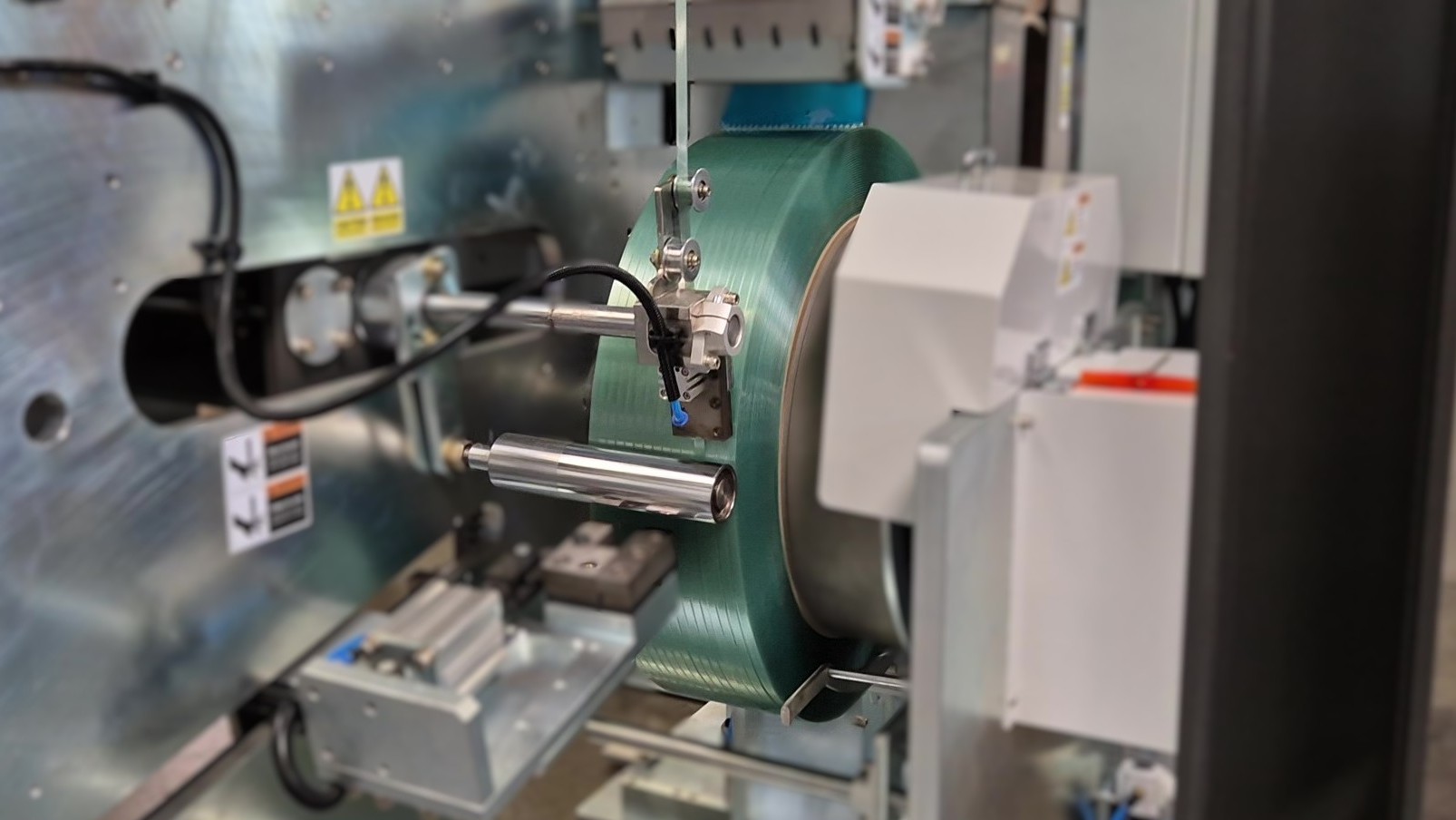
A fully automatic winder is designed to reduce operator intervention during repetitive production. In typical operation, the operator mainly prepares bobbins and monitors the process, while the machine handles more of the sequence automatically, such as bobbin change, cutting, and roll discharge depending on the model.

ItemSemi-Automatic WinderFully Automatic Winder
Main roleAutomatic winding with some manual stepsAutomated winding cycle with minimal operator action
Operator workHigherLower
Bobbin size flexibilityGenerally widerGenerally more limited
Best fitFrequent bobbin size changesRepeated production with stable specifications
Investment levelUsually lowerUsually higher
Layout and control complexitySimplerMore complex

Semi-automatic winder: flexibility first

A semi-automatic winder is often selected when the plant must handle many bobbin specifications. This is common when the production line serves different customers, markets, or strap grades.

One practical advantage of DAESUNG EXT semi-automatic winders is that they can be configured with replaceable bobbin holders. By changing the bobbin holder, one machine can respond to different bobbin sizes. This is useful for plants that do not want to dedicate a separate winder to every product format.

Semi-automatic winders are also easier to justify when production volume is moderate or when product changeover is frequent. The operator remains part of the process, but that can be acceptable if the line does not run long campaigns of the same coil specification.

This type is usually chosen for:

  • Wider response to different bobbin sizes
  • Suitable for mixed production schedules
  • Lower automation complexity
  • Easier adjustment for special or less frequent orders
  • Practical choice when labor is already assigned near the line

The main trade-off is that operator consistency becomes important. Manual steps must be clearly defined, and operators should be trained to maintain stable coil quality, especially during cutting, fixing, unloading, and restarting.

Fully automatic winder: consistency and labor reduction

A fully automatic winder is better suited for plants that run continuous production with stable bobbin specifications. When the same coil format is produced repeatedly, automation can reduce manual handling and improve workflow consistency at the end of the line.

In a typical fully automatic setup, the operator's main tasks are to prepare bobbins, check the winding condition, and manage finished rolls after discharge. This helps reduce repetitive manual work and can make the line easier to manage during long production runs.

For PET strap production, DAESUNG EXT's PET Strap Fully Automatic Winder can also perform wrapping. This helps when PET coils need to move directly from winding to storage or shipment. Integrating wrapping into the winding stage can reduce separate handling steps and keep the finishing area easier to manage.

This type is usually chosen for:

  • Reduced operator intervention during winding
  • Better fit for long, repeated production runs
  • More consistent process sequence
  • Lower dependence on manual timing
  • Possible integration of additional finishing steps, such as wrapping for PET strap

The main limitation is flexibility. Fully automatic winders are generally designed around a more limited range of bobbin sizes. Before selection, the plant should confirm the required bobbin dimensions, coil weight range, inner diameter, outer diameter, and future product plans.

Selection checklist

Before choosing between the two winder types, review the actual production pattern rather than only the current preferred machine type.

QuestionMore suitable option
Do you frequently change bobbin sizes?Semi-automatic winder
Do you run long campaigns with the same coil format?Fully automatic winder
Do you need to reduce manual handling at the winding stage?Fully automatic winder
Is PET coil wrapping required in-line?PET fully automatic winder
Are many customer-specific bobbins used?Semi-automatic winder

Practical recommendation

Choose a semi-automatic winder when flexibility is more important than minimizing operator work. It is especially practical for plants producing many SKUs, serving different customer bobbin requirements, or changing product formats often.

Choose a fully automatic winder when the production target is repeated, stable, and volume-oriented. It is suitable when the plant wants to reduce manual handling at the final stage and standardize the finishing process.

In many strap factories, the best choice depends less on extrusion capacity alone and more on finished product variety. The winder must match how the plant actually sells and ships strap coils. If the winder cannot keep up with bobbin changes, unloading, or packing flow, the extrusion line capacity cannot be fully used.

문의 안내

제품 문의 및 맞춤 제작 요청

제품 사양, 견적 문의, 맞춤 제작 등의 문의가 있으신가요?

문의하기